Engineering Before Equipment Selection
Define the Project Before the Quote
Applied Engineering Insight
Engineering Software & Test Automation
Issue 05 / July 2026 · Martin Weiss
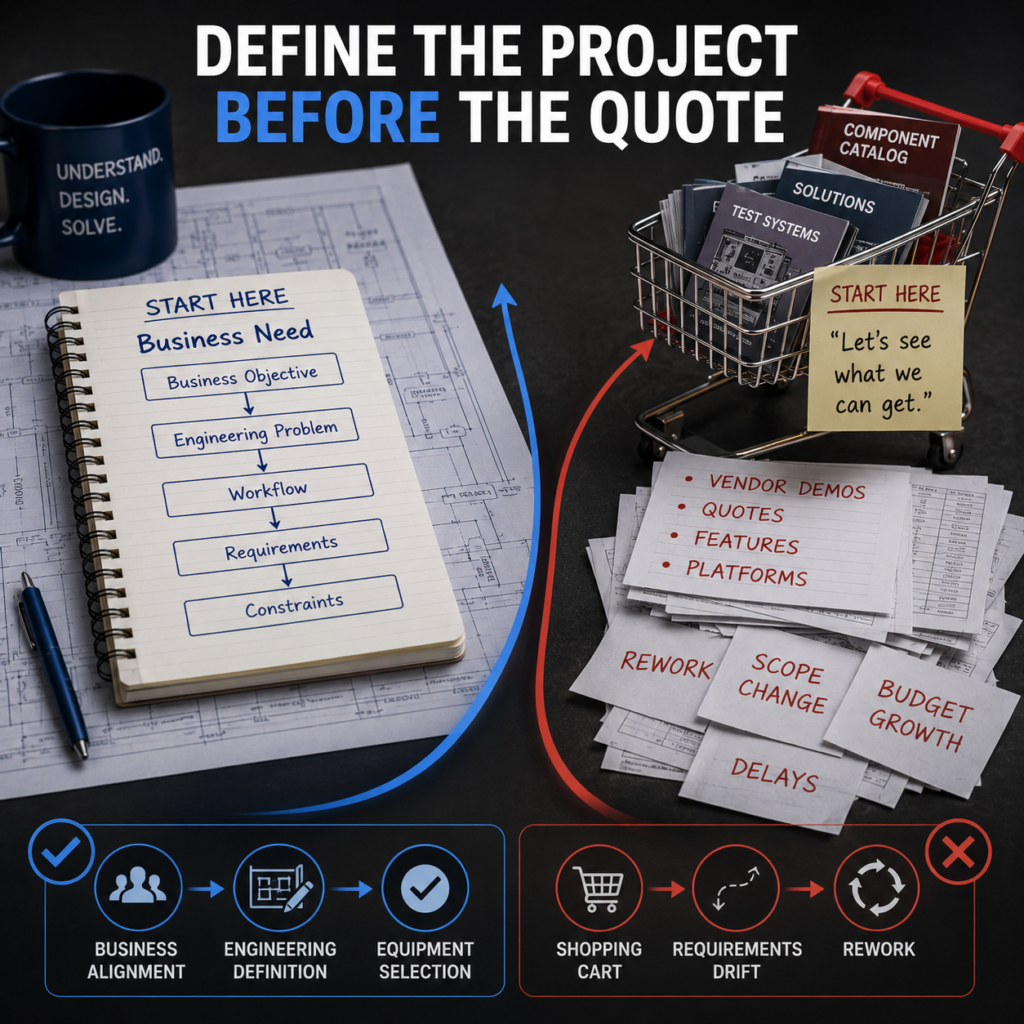
Great engineering projects don’t begin with equipment.
They begin with a shared understanding of why the project exists.
Management defines the business objective. Engineers translate that objective into an engineering problem, workflows, requirements, constraints, and ultimately a practical solution.
Only then does equipment selection become a technical decision instead of an expensive guess.
When that alignment is missing, projects often drift. Requirements evolve without clear justification. Features are added that don’t advance the original objective. Scope expands. Procurement decisions become increasingly difficult to justify. What began as a promising initiative can become delayed, repeatedly rescoped, or in some cases cancelled altogether.
The consequences extend beyond budgets and schedules. Engineering teams can become frustrated after investing months refining solutions to problems that were never clearly defined. Management is left wondering why the project no longer delivers the value it originally expected. Meanwhile, the underlying business objective—the reason the project was initiated in the first place—remains only partially addressed, or not addressed at all.
Successful projects begin with alignment. A clearly defined business need gives engineering the foundation to develop meaningful requirements, evaluate alternatives, and recommend solutions that are technically sound, operationally practical, and aligned with business value.
This article presents a practical framework for helping management and engineering establish that foundation before the first vendor demonstration, equipment comparison, or request for quotation..
More Topics
Test Systems & Validation
Data Integrity & Measurement
Engineering Safety